

.png)


TV Typewriter
In 1973, Don Lancaster, an electronics engineer working for Goodyear Aerospace and an already prolific designer and author of various electronics projects, came up with a device that would change perceptions around the affordability and feasibility of having a computer in one's home.
Released in the September 1973 issue of Radio Electronics Magazine, the TV Typewriter wasn't exactly designed as a computer terminal from the start, but this possible use case became one of the main reasons hobbyists desired to build one. The realization that one could have a computer terminal in one's own home for less than $100 caused a bit of a frenzy, and Radio Electronics was initially unable to keep up with requests for their construction guide, which hobbyists had to write in for, at a cost of five dollars.

The TV Typewriter, or TVT as it became known, was a compact stack of four (or five) boards capable of producing a single page of 512 characters at 32 characters per line and 16 lines total, although with
an optional 'Page B' memory

Don Lancaster (right) seated beside Popular Electronics editor Les Solomon (left).
The magazine "for men with ideas in electronics!"
board one could store 1024 characters. It relied on old school Signetics 2524V shift registers for memory rather than newer and expensive static RAM. The bus Don designed had 60 pins and was designed in such a way as to be able to add expansions or improvements by simply plugging in. Don eschewed complex and expensive cursor control systems, instead relying on a relatively simple counter system to keep track of cursor position. Don's article in Radio Electronics heaped on the superlatives, describing a digital
wonder device:
"It's a super sales promoter, either locally or on a store wide basis. It's easily converted to a title machine for a video recorder. It's a message generator or 'answer back' unit for advanced two way cable TV systems. Tied to a cassette recorder, it's an electronic notebook and study aid, or a custom catalog. It's an annunciator for plant, schools, and hospitals that tells not only that someone is needed, but why and where."
As designed, the TVT did not actually have any means to communicate with the outside world. It would be a little while before a serial communications board was developed by Roger Smith in a subsequent article. But terminal use was by far the most common - if not the only - purpose TVT builders had in mind for their devices.

The Roger Smith communications board article

Don built two prototypes of his TVT. The first, which now resides at the Computer History Museum in Mountainview, California, was classic 1970s chic, featuring a metal top covered by 'tan' colored faux distressed leather, and flanked by wood sides, probably red oak. The keyboard was a unit built by Microswitch originally for Mohawk Data Sciences MDS-20 key-to-tape machines that were being gradually retired at that time. These featured Teletype-

The 4 board stack.
My replica of the first prototype unit.

style rounded keys which appparently were designed that way to accomodate the long nails of predominantly female operators. Don rearranged and painted the keys and added his own decals to them. In fact, more than one of these was produced. According to Don:
"The blue keyboards were rebuilds from IBM EBCDIC keypunch versions bought surplus. There were about 60 of them that rebuilt into 46 or so tvt keyboards."
One of the 'surplus' keyboards Don refurbished for hobbyists. (Credit: tgarnold)

The 'cover' unit: sadly lost.

The second prototype was the unit featured on the September 1973 cover of Radio Electronics. This was more 'pro' looking device, essentially the same machine underneath a more refined shell, featuring a full size, typewriter-style homebrew keyboard Don had designed an published a few months before the TVT itself. The fate of this device isn't known. I did ask Don about it, but he wasn't sure. Best guess was the magazine kept it (it wasn't uncommon for magazines to take ownership of devices they featured in their pages) and then it disappeared into the mists of time (or trash) sometime before or after the magazine went defunct.
I do not know for sure who did the original artwork layout for the board set. The resulting boards would eventually be produced by SWTPC and offered as the official 'kit' by Radio Electronics, for about $40 in 1973 money, and the 'mainframe', or motherboard, bears their logo. It might have been Don himself (I regret I never asked him), or it might have been SWTPC acting on a schematic provided by Don. Hard core hobbyists were provided copies of this artwork in the RE Construction guide, so they could etch their own boards if desired.

My replica TVT coming to life!


The TVT 'mainframe' board artwork, bearing the SWTPC logo
Building a TVT was straightforward but definitely not easy. Apart from initial difficulties getting one's hands on the RE construction guide, one then had to find parts, some of which were still pretty new and hard to find at the time. Then came the build process. The stackable design, while compact, involved Molex connector pins which had to align perfectly with the socket below them and were prone to breaking if one wasn't careful. Mistakes could be costly. Accidental solder bridges were all too easy to make with traces and components packed tightly together. The construction guide contained an admonition from Don to follow the steps exactly and in precise order, proceeding from each step to the next only when everything was working as expected. Many hobbyists - including myself 40 years later, heh! - ignored this advice, following their usual practice of building by schematic and ended up with devices that partially worked or didn't work at all. In fact, the schematic had some errors that all but assured major issues. Luckily, the PCBs were correct. Don eventually produced an 'errata' sheet that clarified issues builders had discovered, in response to write-in inquiries to the magazine.

If you got this far in the project, you were doing great!
For those that succeeded, as a terminal the TVT was operationally less than ideal. The simple cursor control and memory system did not allow for scrolling or even a proper delete function. When the bottom of the selected memory page, or screen, was reached, the TVT's counters simply reset, and the cursor began overwriting what was up top. You could, if you had the second page of memory, flip a switch to go over to the second page before that happened, but this was less than ideal. The TVT was also effectively speed limited at 1200 baud, which eventually became unacceptably slow as home computer use proliferated.
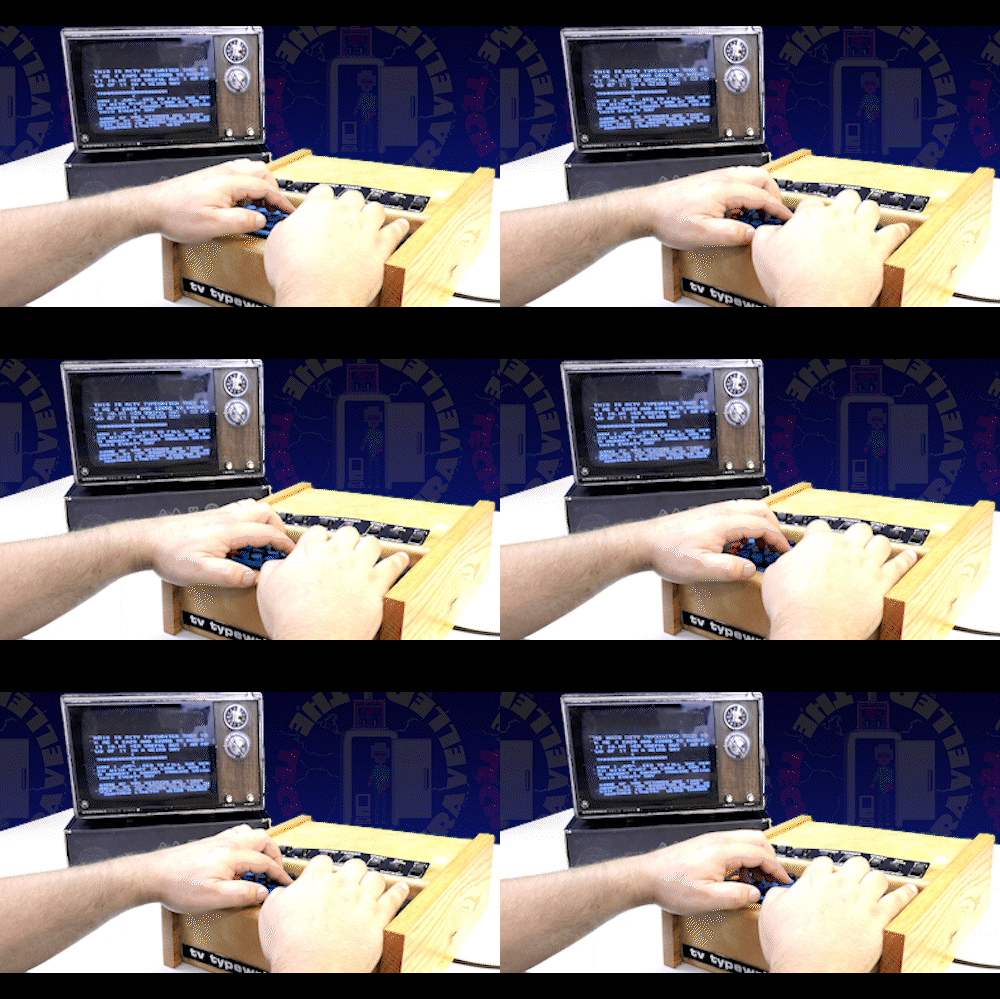
TV Typewriting in action!
Nevertheless, the TVT was affordable, and that's what mattered. By providing a design average people could afford, Don had opened the floodgates to the personal computer revolution that would soon follow. The TVT inspired SWTPC founder and owner Daniel Meyer to ask an engineer of his, Ed Colle, to design an improved version, dubbed the TV Typewriter II. This one would be specifically designed for use as a computer terminal to complement the future Southwest 6800 computer system.
I actually produced a video about the TV Typewriter. Definitely check it out if you want a more detailed history, as well as footage of one actually operating!